
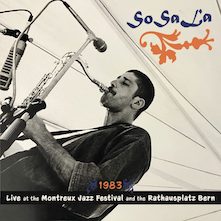
 The Montreux Jazz Festival
1. Confusing World (10:10)
2. MJF’s When I’m Crazy, I’m Normal (4:08)
3. Let’s Have a Good Time (11:53)
4. MJF’s Ningen in Africa, Ningen in Nippon (7:29)
5. MJF’s SA SI SU SE SO (3:46)
Rathausplatz Bern
6. 1-2-3-4 (5:10)
7. Paul Klee Musical Colors (8:44)
8. Zehn Vor Vier in Bern (9:44)
—————————–
The Montreux Jazz Festival
1. Confusing World (10:10)
Sound: Progressive Rock/Noise
The Izumi-Usami duo performed the intro song, interacting musically with Sadato’s off- and on-stage performance.
Sadato began his act from within the audience, with a swimming pool in the middle. He approached the stage with slow and dramatic movements in the Butoh dance style. Izumi’s long guitar melodic noise and Usami’s freestyle Rhodes mellow sounds created a psychedelic ambience, which switched to the drums playing freestyle, culminating in a heavy, funky 4/4 rock beat.
To give his performance more dramatic impact, Sadato was dressed in a Japanese Kendo uniform, wearing a Noh mask on his face, covering his head with a towel, carrying a backpack on his back with a toy gun inside, and holding a Japanese fan in his right hand.
Izumi and Usami started playing that heavy 4/4 rock beat when Sadato reached the stage.
Sadato took his position in front of the vocal mike and stood still, miming the “confusion of the world” with the Noh mask and making bizarre head and neck movements. The audience freaked out when they saw Sadato’s act, which they hadn’t seen before.
Sadato’s stage performance was intended to confuse and surprise the audience with unseen images, movements, and sounds.
2. MJF’s’s WheI’m’m CrazyI’m’m Normal (4:08)
Sound: indie rock/NO WAVE/Downtown Music/Protest Song
The title and the lyrics speak for themselves. Sadato felt like a “lousy Japanese” with white skin. The Japanese people and media called him “Henna Gaijin” or “Nazo No Sadato,” which means “Strange Foreigner” or “Mysterious Sadato.” Called by these terms, Sadato felt the opposite about himself: being an “ordinary” person.
3. Let’s Have a Good Time (11:53)
Sound: free jazz/noise/funky progressive rock/
After the noisy intro of this song, it was time for the audience to dance. Sadato switched to the soprano sax to make the sound lighter. Izumi switched to electric bass. But when Usami switched to a very fast 4/4, Sadato switched to the tenor and played an Albert Ayler-style tenor sax solo. Surprisingly, the audience had no problem following the aggressive performance of this trio. On the contrary, it enjoyed the high-energy performance. The song ends with Sadato hitting a chord on the Rhodes piano.
4. MJF’s Ningen in Africa, Ningen in Nippon (7:29)
Sound: free Afro Beat/protest song
Free noisy Afro Beat with Sadato on the Rhodes in the beginning and on a “jungle” sounding soprano sax and tenor sax later, joined by Usami’s African polyrhythmic textures and Izumi’s Hendrix-like playing intertwining with Sadato’s vocals. In this song, Sadato expressed lyrically (Ningen means “man”, “people” or “human being”) and musically (playing the soprano) how he felt about the absurdity of life and politics; and how he looked at people in general, making fun of their hypocrisy.
5. MJF’s SA SI SU SE SO (3:46)
Sound: groove/progressive rock/free rock
This grooving song is the outro of the concert in which Sadato successfully gets the band and audience in perfect unison. The ending is theatrical. Later in Sadato’s career, this song became a hit and was rearranged and released in two different-sounding variations.
Rathausplatz Bern
6. 1-2-3-4 (5:10)
Sound: indie rock/free jazz
Sadato’s performance consists of two elements: the music and his stage performance. He executed full self-expression by playing his sax and other instruments. The lyrics speak out to the audience. And his stage performance wearing the Keiko-gi and doing specific body movements to attract the audience’s attention. This track is a good example of how Sadato and his band interacted with the audience.
7. Paul Klee Musical Colors (8:44)
Sound: free fusion/jazz on drugs
This track features Izumi’s unbelievable bass playing (Jaco Pastorius would be jealous of him) and Usami’s drumming on his side. Sadato was acting dramatically on and off stage. At the end, he joined the band on tenor sax, playing an Aylerish free jazz tenor sax solo, exploded by the band’s fast 4/4.
F.Y.I.: Sadato was a fan of the Swiss-German painter Paul Klee, whose individual style was influenced by movements in art that included expressionism, cubism, and surrealism. Sadato liked how Klee experimented with and eventually deeply explored color theory. He had no problem thinking of sounds as specific colors because music is an art form that evokes people’s imaginations, in which colors could play an important role.
8. Zehn Vor Vier in Bern (9:44)
Sound: up-tempo four-beat/harmonica feature/City Hall bells.
Sadato speaks to the audience in German, provoking the audience, proclaiming “Die Mehrheit sagt nicht die Wahrheit,” translated into English as “The Majority doesn’t say the truth,” promoting the band, asking for financial support for the following year’s tour, and saying goodbye.
F.Y.I.: Sadato cares much about time as it is lived and felt. During a performance, he loved to announce the time to make people aware of the importance of time and their being or existence when they heard the time announcement.
〜 release info
 SO SA LA / 1994 , LIVE AT CBGB
 SO SA LA / NU WORLD TRASHED
 FRANÇOIS KOKELAERE & CÉDRIC RICARD / PERCUSSION & SAXOPHONE
 V.A. / THE ROUGH GUIDE TO WORLD JAZZ